

Since ancient times, the "matanzas" (the traditional pig slaughter) have been carried out in winter — not only in Mallorca, but also in other Spanish regions and other countries. Since antiquity, coinciding with the winter solstice, the pig was slaughtered to ensure food during the cold months.
Traditionally, raising and fattening a pig was one of the most common ways to sustain a family's food supply, as it guaranteed meat consumption throughout the entire year.
Family and friends gather in a spirit of mutual help and celebration
The pig slaughter is a practice with a meaning far deeper than the simple act of slaughtering an animal for personal consumption — on the occasion of this event, family and friends gather in a spirit of mutual help and celebration.
A traditional day of "matanzas"
The preparation
The day before, the seasonings are bought and the utensils, machinery, knives and firewood are prepared.
Dawn
The day of the "matanzas" begins before sunrise, when the "matancer" (butcher) and helpers tie the pig once it has been placed on the bench. Before getting to work, the women have already set a pot of water to boil, which will later help clean and shave the pig.
The slaughter
When everything is ready, the "matancer" slaughters the animal with a knife, without causing it to suffer, while a woman with a basin collects the blood that will be used to make the traditional blood fry, a typical mid-morning snack.
Cleaning and butchering
Using hot water and special knives, the pig is shaved. In the old days there were special rules: the butcher had the right to cut the shoulder hairs, the longest ones, which were used to make brushes. The tail was for the children, who used it for their games.
Once the pig is shaved, the work continues by opening the pig down the middle and separating the different parts. Nothing is wasted; everything is used. The men cut the meat into pieces while most of the women are in the kitchen, preparing the meal.
The intestines
The tasks continue with the extraction of the intestines. This is done by hand and with great care, as a rupture would soil the pig's loin. The village veterinarian, notified in advance, analyses a sample of the meat to verify that the pig is good and healthy.
The women prepare the intestines where the mixtures will be stuffed. They clean them with vinegar, lemon and salt. Some break and must be sewn — a task that takes a couple of hours. The thinnest intestines are used for butifarrones and the rest for sobrasadas and longanizas.
The break: the "frit de matanzas"
At midday it is time to rest. The "madona" (lady of the house) will have already prepared the typical "frit de matanzas" (blood fry). For lunch there are biscuits, dried figs, roasted snout, wine, liqueurs… It is a well-deserved rest, by which point the slaughter is well advanced.
Making the cured meats
In a large container, after passing through the grinder, all the sobrasada mixture is placed, and in another, the mixture for the remaining cured meats. The mixture is constantly stirred while the women taste it as they go.
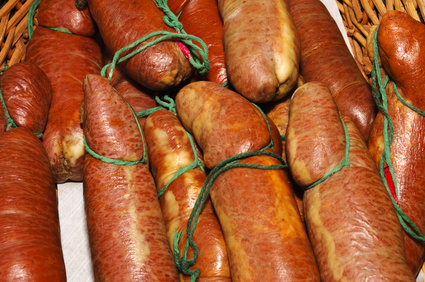
The sobrasada meat contains lean meat (the higher quality) and a little fat. The butifarrón mixture contains fat and blood. The seasonings for the sobrasada are paprika (pimentón), black pepper and salt. More spices are added to the butifarrón, although each family has its own custom.
An elder is in charge of salting the meat for the cured meats. These are usually people with long experience who perform their task "by eye".
The stuffing
The next step also takes several hours. The casings must be filled with the meat mixture. Traditionally this was a task for the men, while the women sealed them as they came out of the machine.
Using a special thread or cord, the filled casings are separated into individual pieces. This work is done without pause, as the men continue filling and the sewing must be immediate.
Butifarrones and curing
If they are butifarrones, once prepared they are boiled for just over half an hour and, once cool, they are ready to eat. Sobrasada, on the other hand, is consumed raw or cooked after a curing period (15 days for longanizas).
The end of the day
After this, the slaughter can be said to be finished. The cured meats are hung in the larder and some of them are shared among family and neighbours on the very day of the "matanzas". Their opinion and taste determine the satisfaction of the homeowners.
The "ventrisca" (belly) is frozen or salted, and the bones are salted and preserved in an "alfàbia" (large clay pot) to later make stews. It is clear that from the pig, everything is used.
The celebration
With the work done, it is time for celebration. In the old days, once the "matanzas" were finished, a large fire would be lit around which people roasted and danced to traditional songs. Nowadays, this tradition has largely been lost, although in many Mallorcan villages the matanzas are still celebrated as a community event.